NEW YORK, November 16, 2026 — New York City Mayor Zohran Mamdani and Police Commissioner Jessica Tisch announced Monday that the city will disband the New York Police Department’s Strategic Response Group, separating protest response from counterterrorism operations and creating new teams focused on communication and de-escalation.
The decision fulfills a campaign promise by Mamdani, who argued that demonstrations protected by the First Amendment should not be handled using the same framework as terrorism threats. The announcement also marks a significant change in how the nation’s largest police department prepares for large public gatherings, although the city says the reforms will not change the department’s overall headcount or require additional spending.
How the new structure will work
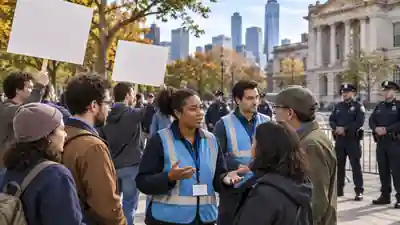
The city plans to create a Community Dialogue and De-escalation Division within the Mayor’s Office of Community Safety. The civilian-led division will help plan for demonstrations and communicate with organizers and participants. It will not carry weapons or have arrest powers, according to the mayor’s office.
The NYPD will establish a 30-officer First Amendment Support Team within its Community Affairs Bureau. The team will be trained in communication and de-escalation and will work with the civilian division as the new structure is built. A separate Patrol Support Division will include vetted officers who receive specialized crowd-management training. Those officers will primarily perform patrol-related duties but may support demonstrations and make arrests when necessary.
The administration said the new arrangement is intended to make dialogue the first response while retaining police capacity for serious incidents. It also said the changes will be implemented without increasing or reducing the NYPD’s staffing level.
Restrictions on crowd-control tactics
The announcement includes new restrictions on tactics and equipment used during First Amendment activities. The city said officers will be prohibited from using kettling, a tactic that surrounds a crowd and restricts movement, as well as tear gas and long guns for protest crowd management. Pepper spray will not be used as a general crowd-control tool. Long-range acoustic devices will be limited to 90 decibels.
The SRG’s counterterrorism responsibilities, including deployments of heavy weapons at critical infrastructure, will move to the NYPD’s Intelligence and Counterterrorism Bureau. The city says that separation will allow the department to maintain specialized security functions without assigning the same unit to protest policing.
Support and criticism
Civil liberties advocates have long criticized the SRG’s role at demonstrations, arguing that its tactical orientation can escalate encounters with protesters. The unit was established in 2015 and became a visible presence at large protests, including demonstrations following the 2020 killing of George Floyd. A New York City Department of Investigation review after those protests recommended that the NYPD reconsider the unit’s central role in handling large demonstrations.
Police union leaders criticized Monday’s decision. The head of the Police Benevolent Association said the changes could make it harder for officers to respond when demonstrations disrupt streets or create public-safety problems. Tisch, however, said she supported the new structure and would not back changes that weakened the department’s ability to respond to serious threats.
What it means for U.S. readers
New York’s decision will be watched by other cities that use specialized police units for demonstrations, large events and emergencies. The practical test will be whether civilian dialogue teams and trained patrol officers can reduce confrontations while still responding effectively when violence or other crimes occur.
The announcement is a policy change, not evidence that all protest-policing disputes have been resolved. The city will need to publish implementation details, train personnel and explain how the new units will coordinate during fast-moving events. For residents and visitors, the immediate point is that protest response is being reorganized, while counterterrorism duties remain with the NYPD.
Sources and reporting credit
This original report is based on the city’s announcement and independent reporting: