


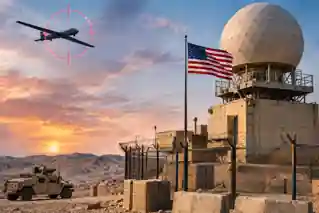
Iran widened its attacks across the Persian Gulf on Wednesday, Nov. 18, with strikes reported around a U.S. air base in Kuwait and additional attacks in Bahrain, after American forces hit an Iranian missile-launch site on Qeshm Island a day earlier. The developments raised the risk of a broader confrontation near Gulf military facilities and shipping routes, although the countries involved gave different accounts of the targets and damage.
The Associated Press reported that Iran targeted Ali Al Salem Air Base in Kuwait and launched attacks at sites in Bahrain. Iran’s state broadcaster said the operation was aimed at U.S. drone and missile installations at the Kuwaiti base. Kuwait’s Army General Staff confirmed that its air defenses were responding to hostile drone attacks, but its initial statement did not identify where the drones came from or specify whether the base had been damaged.
In Bahrain, the Interior Ministry issued shelter alerts early Wednesday and later announced that the threat had passed. Bahrain’s military said it had intercepted a number of attacks but did not immediately provide details about casualties or damage. Bahrain hosts the U.S. Navy’s Fifth Fleet, a central part of American naval operations in the region.
The exchange followed a strike on Qeshm Island
A U.S. military official told Reuters that American fighter aircraft struck an Iranian missile-launch site on Qeshm Island on Tuesday, Nov. 17. The official said the operation responded to Iranian attacks on U.S. personnel and assets, but provided no further details about the weapons used or the extent of damage. Qeshm sits near the Strait of Hormuz, the narrow waterway connecting the Persian Gulf with the Gulf of Oman.
Iran’s latest claims followed earlier attacks on Bahrain. On Tuesday, the Islamic Revolutionary Guard Corps said it had launched drones at a U.S. military radar system at Sheikh Isa Air Base. Bahrain said its air defenses intercepted the incoming attack. U.S. Central Command said the drones were destroyed before reaching their targets and reported no damage to American equipment or injuries to U.S. personnel in that incident.
Why the bases and shipping lanes matter
Ali Al Salem is an important installation for U.S. and allied operations in Kuwait. Bahrain’s role is especially significant because it hosts the Fifth Fleet. Attempted attacks near these facilities can put service members, contractors and civilians at risk even when air defenses intercept incoming weapons.
The Strait of Hormuz carries a substantial share of the world’s seaborne oil and liquefied natural gas. A prolonged threat to tankers or navigation can raise shipping insurance costs, disrupt deliveries and add volatility to energy prices. Americans may feel those effects through gasoline, heating and transportation costs even if the fighting remains overseas.
What is known — and what remains unconfirmed
Kuwait’s public statement confirmed that its air defenses were engaging hostile drones, but did not independently attribute them to Iran. Iran’s state media claimed an attack on U.S. installations at Ali Al Salem, while AP reported that Kuwait had not immediately confirmed damage or casualties. Bahrain confirmed interceptions and shelter alerts but did not publish a full assessment of the latest attacks.
The wider conflict has already disrupted regional shipping and complicated efforts to restore tanker traffic through the Strait of Hormuz. AP reported that negotiations remain stalled over navigation and security issues. Qatar has been involved in diplomatic efforts, but no new agreement was announced alongside Wednesday’s attacks.
What it means for Americans
The immediate U.S. concern is the safety of American personnel and the protection of bases used for regional operations. The longer-term concern is whether repeated exchanges draw more Gulf states into the conflict or threaten commercial shipping. Public statements available Wednesday did not establish American casualties from the latest incidents or provide a complete damage assessment.
For now, confirmed defensive actions should be separated from claims about intended targets. Kuwait and Bahrain reported interceptions; Iran claimed it targeted U.S. facilities; and Washington confirmed a strike on Qeshm Island through an official who spoke to Reuters. Further military statements will be needed to establish the precise sequence, damage and casualties.
Sources
- The Associated Press: Iran widens Gulf attacks in Kuwait and Bahrain — Nov. 18, 2026
- Reuters: U.S. strikes Iranian missile-launch site on Qeshm Island — Nov. 17, 2026
- Reuters: Bahrain reports intercepted Iranian attacks — Nov. 17, 2026
- Kuwait Times / KUNA: Kuwaiti air defenses intercept hostile drones — Nov. 18, 2026
- Anadolu Agency: Bahrain says air defenses intercept aerial attacks — Nov. 17, 2026
Image note: This is an original AI-generated conceptual illustration of a radar installation and drone silhouette. It is not a photograph of Ali Al Salem Air Base, Sheikh Isa Air Base or an actual interception.

